
NEW! Dr. Paul T. P. Wong’s FREE e-book:
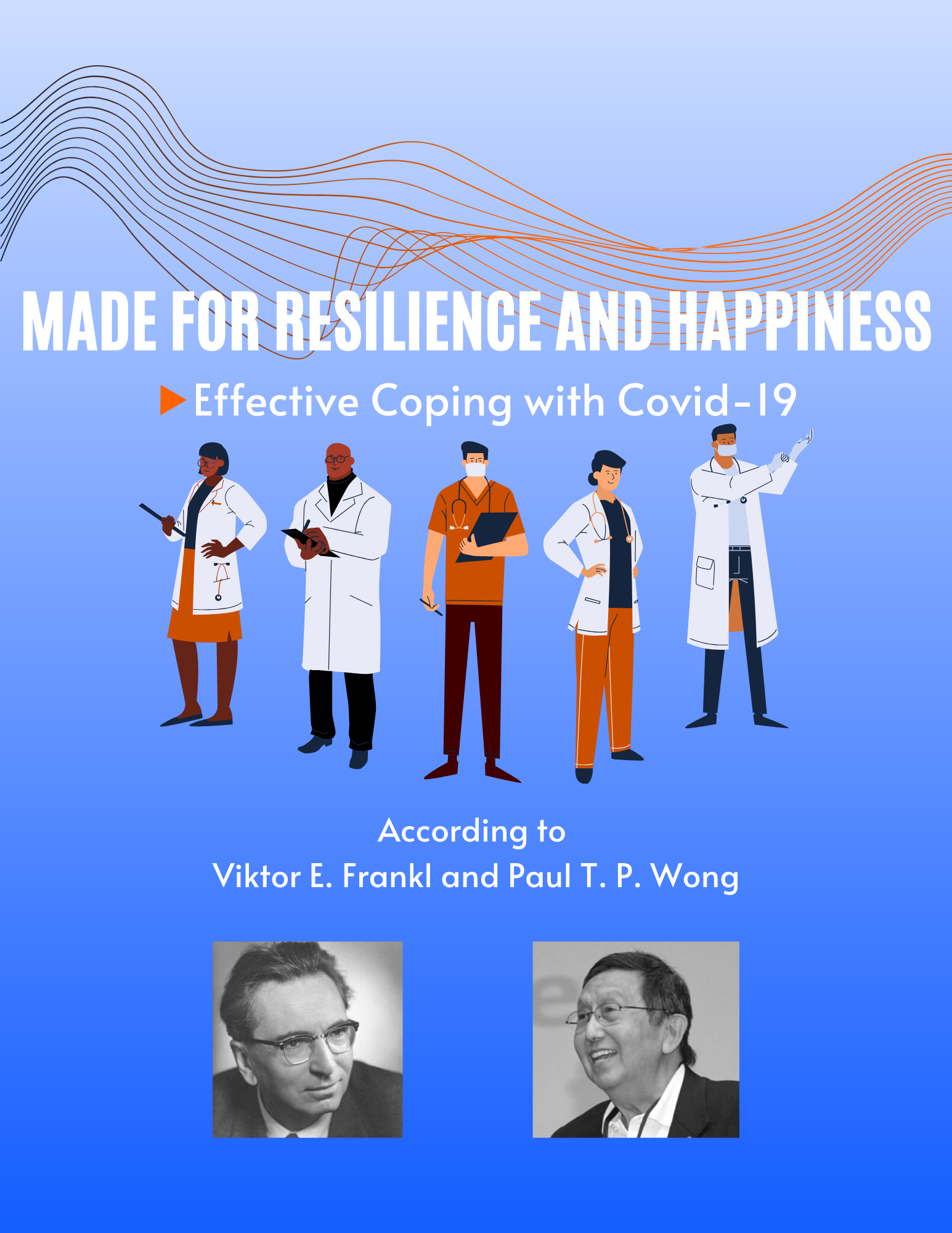
Made for Resilience and Happiness: Effective Coping With the COVID-19 According to Viktor E. Frankl and Paul T. P. Wong
This book is a response to the enormous threat to our mental health posed by COVID-19. The pandemic has exposed both the inadequacy of our present mental health system and the inherent limitations of human beings. The traditional way of facing disruptions with individual strengths is no longer adequate in overcoming this global disaster, which calls for a collective and transformative way of coping.
 Copyright © 2020 Paul T. P. Wong, all rights reserved, published by INPM Press, Toronto, Ontario, 2020. Made for Resilience and Happiness: Effective Coping with COVID-19 According to Viktor E. Frankl and Paul T. P. Wong is assigned ISBN 978-1-7987695-2-3.
No parts of this publication may be reproduced, stored in a retrieval system, or transmitted in any form or by any means, electronic, mechanical, photocopying, recording, or otherwise, without prior written permission of the copyright owner. Book Design by Tim Yu
Dr. Paul T. P. Wong
Psychologist, Researcher, and Speaker
Publications
Psychological Instruments
Meaning Therapy
Positive Psychology
Existential Psychology
Book & Film Reviews
Meaning Therapy
Positive Psychology
Existential Psychology
Book & Film Reviews
International Network on Personal Meaning
The mission of the INPM is to advance the vision of Dr. Frankl and Dr. Wong through meaning research, meaning-centered practice, and meaningful living groups.
The INPM advocates the big-tent approach of extending existential psychology — particularly logotherapy — by integrating it with positive psychology research through collaborative efforts.
Meaning-Centered Counselling Institute
The MCCI offers therapy, supervision, consultation, and training from a meaning-centered approach. It operates out of Toronto, Canada and provides its services internationally.
The MCCI is home of meaning therapy, an evidence-based, integrative existential positive psychotherapy. Its motto? “Meaning is all we have; relationship is all we need.”
Autobiography
Any well-lived life is worth telling and retelling as it can help others who feel overwhelmed and defeated.” (from the Prologue)
Dr. Wong’s story is one of transformation and triumph despite tragedy, from his origins as a melancholic child in China, an impoverished refugee in Hong Kong, a fervent convert to Christianity, and a mistreated minister in Toronto — all the way to an influential professor and psychologist on the world stage who has spoken in multiple cities across four continents.
What are the secrets of his survival and success in this harsh and turbulent world? Dr. Wong’s answer may be surprisingly simple and yet complicated — the pursuit of meaning!
“There is no other motivation more powerful and more transformative. All my life, day in and day out, sunshine or storm, paid or unpaid, healthy or sick, and even now in my old age, I have struggled in my quest for meaning, with little reward or recognition. What has sustained me is the deep conviction that I can bring meaning and thus happiness to the suffering masses.” (from the Prologue)
Prologue
I was finally able to overcome my years of resistance to completing my memoir when I came to the difficult decision that some of the people who had caused me great harm needed to be named, the reason being so that they or people like them could not continue to inflict pain on innocent people with impunity. An even more compelling reason was that my story of overcoming would encourage others to move forward with courage, grit, and faith rather than wallowing in self-pity as victims…
Chapter 1: Is There Life After 80?
When I started doing research more than 30 years ago, the literature seemed to suggest that everything about the human body began to fall apart after 80. Now that this dreaded age will soon be upon me, I am very surprised to discover that, apart from the daily aches and pains, I am actually enjoying my most productive years. In many ways, I am having a second childhood. Free from any obligatory work and financial worries, I have the luxury of sleeping in and doing as much or as little as I wish…
Chapter 2: My Country, My People, My Identity
1937 was an unforgettable and dreadful year in Chinese history. In that year, Japan launched a full scale invasion of China and committed the Nanjing (Nanking) massacre—the forgotten holocaust of World War II…
Chapter 3: The Good and Bad of My Family of Origin
First, the larger drama of the contemporary Chinese history of wars and the Chinese Diaspora. My adult life represents the fears and hopes of millions of overseas Chinese struggling to survive and take root in a foreign land amid discrimination and prejudice. Second, the long history of my family of origin and ancestors. I carry not only their genes, but also hundreds of family stories, told and retold through many generations. Third, the big story of God invading human history and intervening in individual lives. My spiritual quest for meaning, first through Chinese folk religion, then Christianity, has always been the undercurrent of my life…
Chapter 4: My Father — Unsinkable...
By all worldly standards and measures, his life was very successful in terms of possessions, positions, and the achievements of all his children. He was able to enjoy all the fine things money could buy and indulge all his sexual fantasies. Many people would think that such a life is worth dying for.
Ironically, after living vicariously through his dream and observing the shallowness of his life and that of his rich friends, I developed an allergic reaction to the mindless pursuit of personal success and happiness. Even in my primary school, I knew intuitively that there was something missing in my father’s life…
Chapter 5: My Mother — Self-Transcendence...
Perhaps it is because my sorrow has transformed into something transcendental and spiritual. Or it is because I had lived overseas most of my adult life. However, the most likely explanation is that I have never formed an emotional attachment with her. I cannot remember a single occasion of being hugged by my mother, because she was not a cuddly person and had to manage a household of eight children…
All Chapters
Chapter 7: Benedict C. H. Wong (王敬羲): A Heroic Struggle for Existential Significance
Chapter 8: Helen Wong Chao (趙王德珍): A Modern Mulan Who Saved Her Family
Chapter 9: My Brilliant Younger Brothers: Constant, Giles, Joshua, Oscar
Chapter 10: Looking Backwards and Looking Forwards
Chapter 11: The Story to Live By
Chapter 12: Farewell, China
Chapter 13: Hong Kong: A Haven for Chinese Refugees
Chapter 14: A Year of Awakenings
Chapter 15: Pui Ching and Life’s Tough Lessons
Chapter 16: The Many Faces of Poverty
Chapter 17: My Conversion: The Beginning of a New Adventure
Chapter 18: Baptism by Fire: The Untold Story of the Toronto Chinese Gospel Church
Chapter 19: The Joy and Suffering of Christian Ministry
Chapter 20: My Last Words for the Church
Chapter 21: Reflections on My Psychology Career: Where I Came From, and Where I Am Going
Chapter 22: Why I Love Taiwan: My Academic Home
Chapter 23: My Losing Battle Against Publication Bias
Chapter 24: The Untold Story of the INPM
Chapter 25: The Untold Story of Second Wave Positive Psychology
Chapter 26: Once a Teacher, Always a Teacher
Chapter 27: Living with Cancer and Pain
About Dr. Wong
Editor of the InternationalJournal of Existential Psychology and Psychotherapy, he has also edited two influential volumes on The Human Quest for Meaning. A prolific writer, he is one of the most cited existential and positive psychologists. The originator of Meaning Therapy and International Meaning Conferences, he has been invited to give keynotes and meaning therapy workshops worldwide.
He is the recent recipient of the Carl Rogers Award from the Society for Humanistic Psychology (Div. 32 of the APA) and a member of a research group on Virtue, Happiness, and the Meaning of Life, which is funded by a major research grant from the John Templeton Foundation.
 Meaning Conference 2025 will be the INPM’s first in-person conference with a virtual option after the pandemic.